
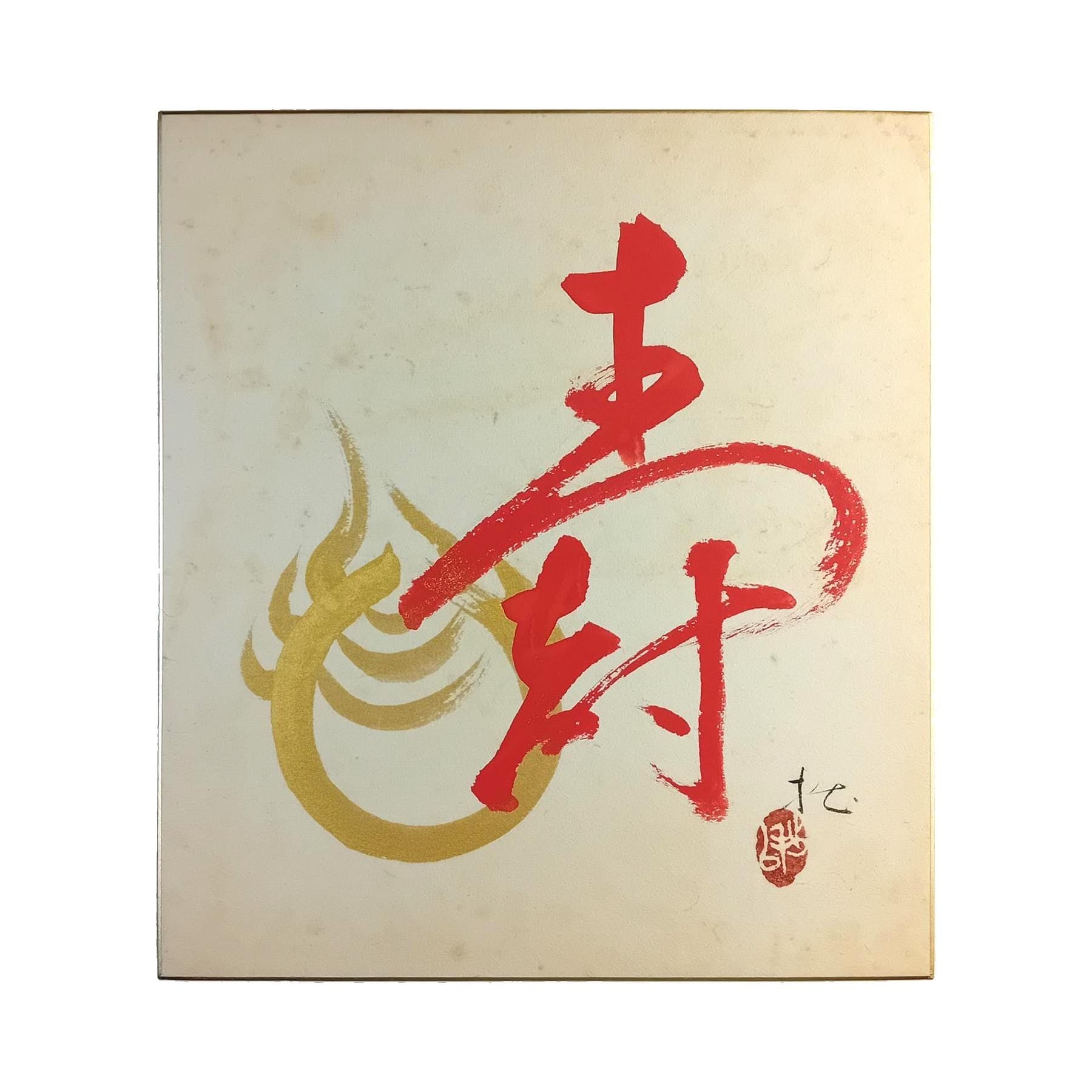
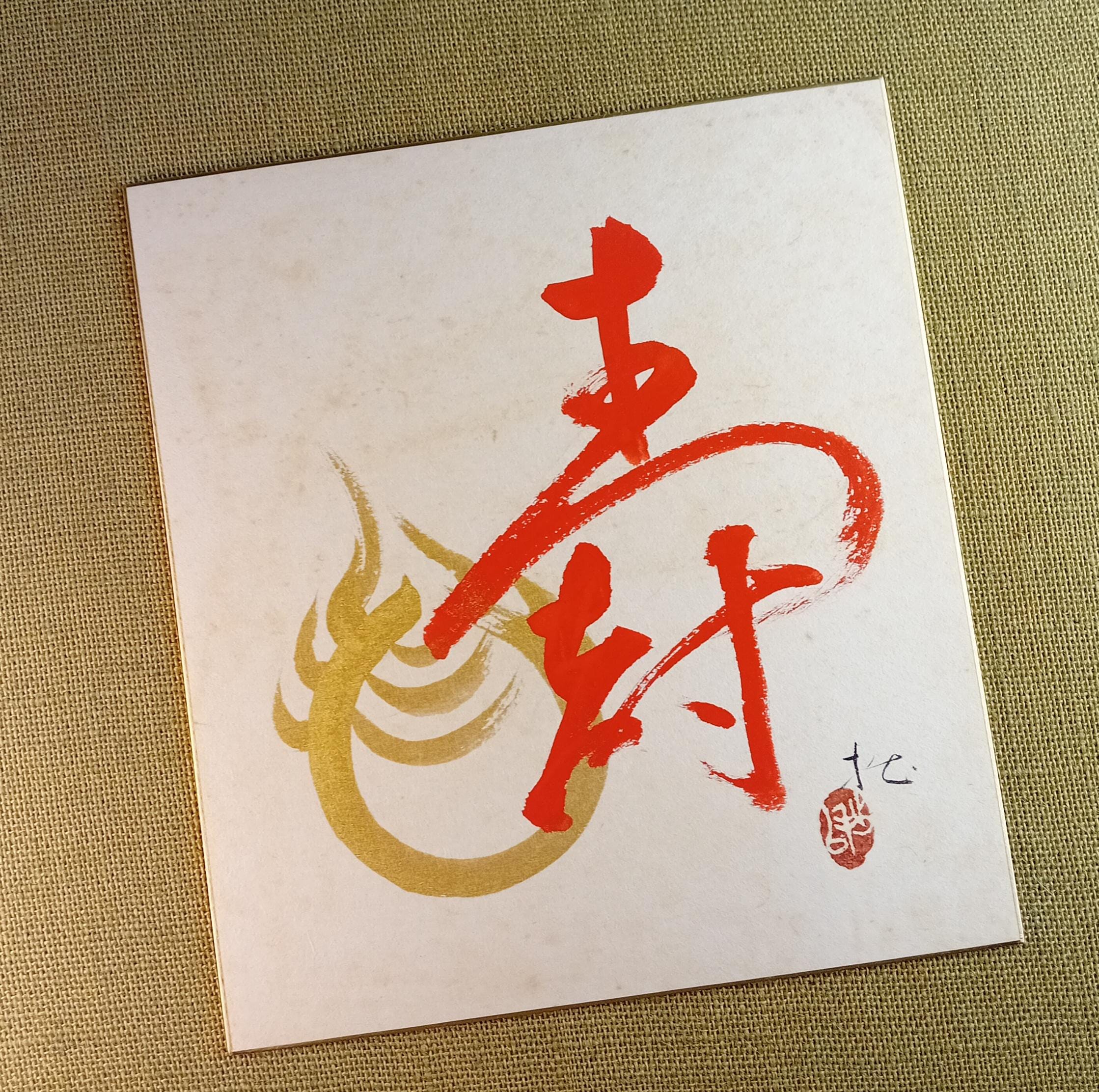
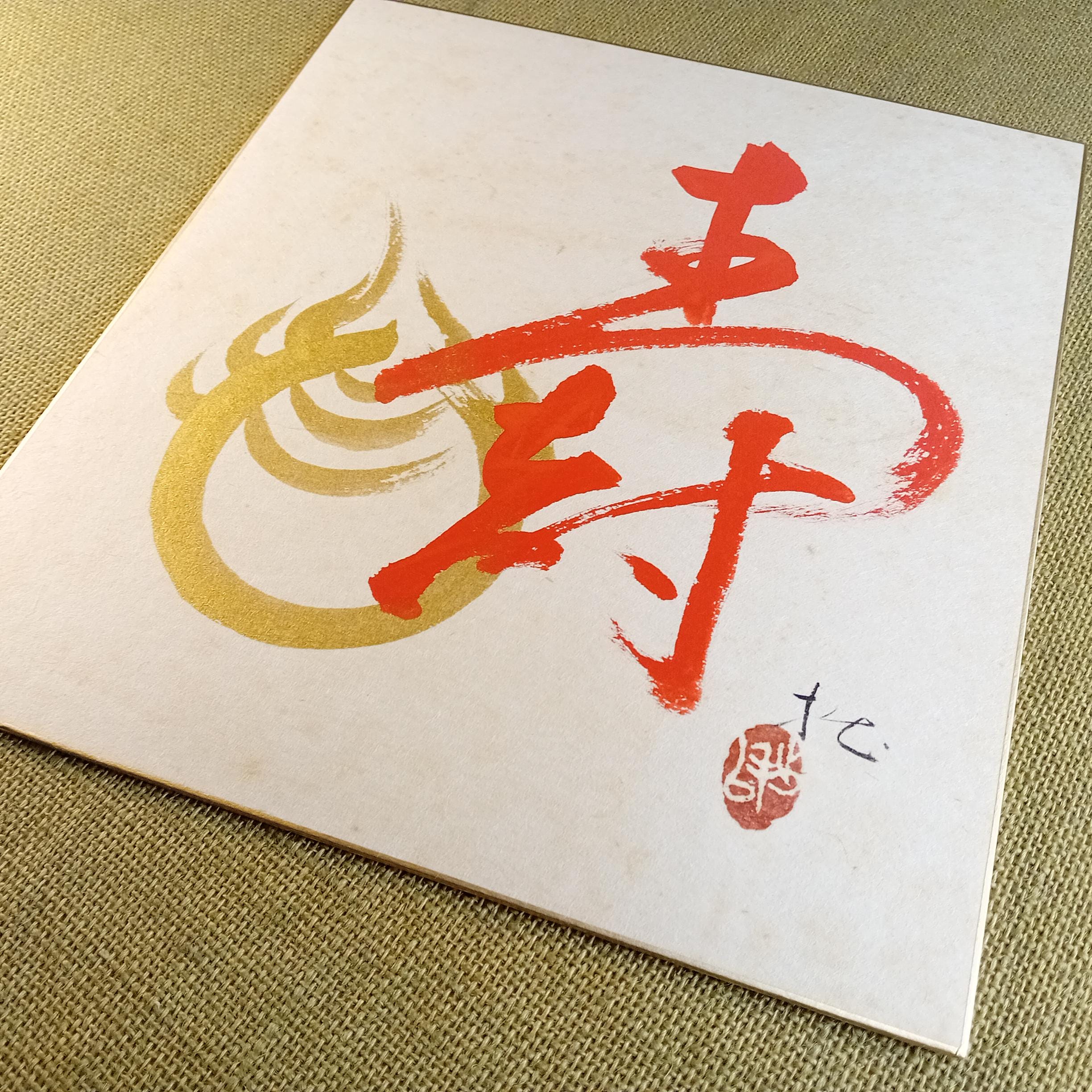
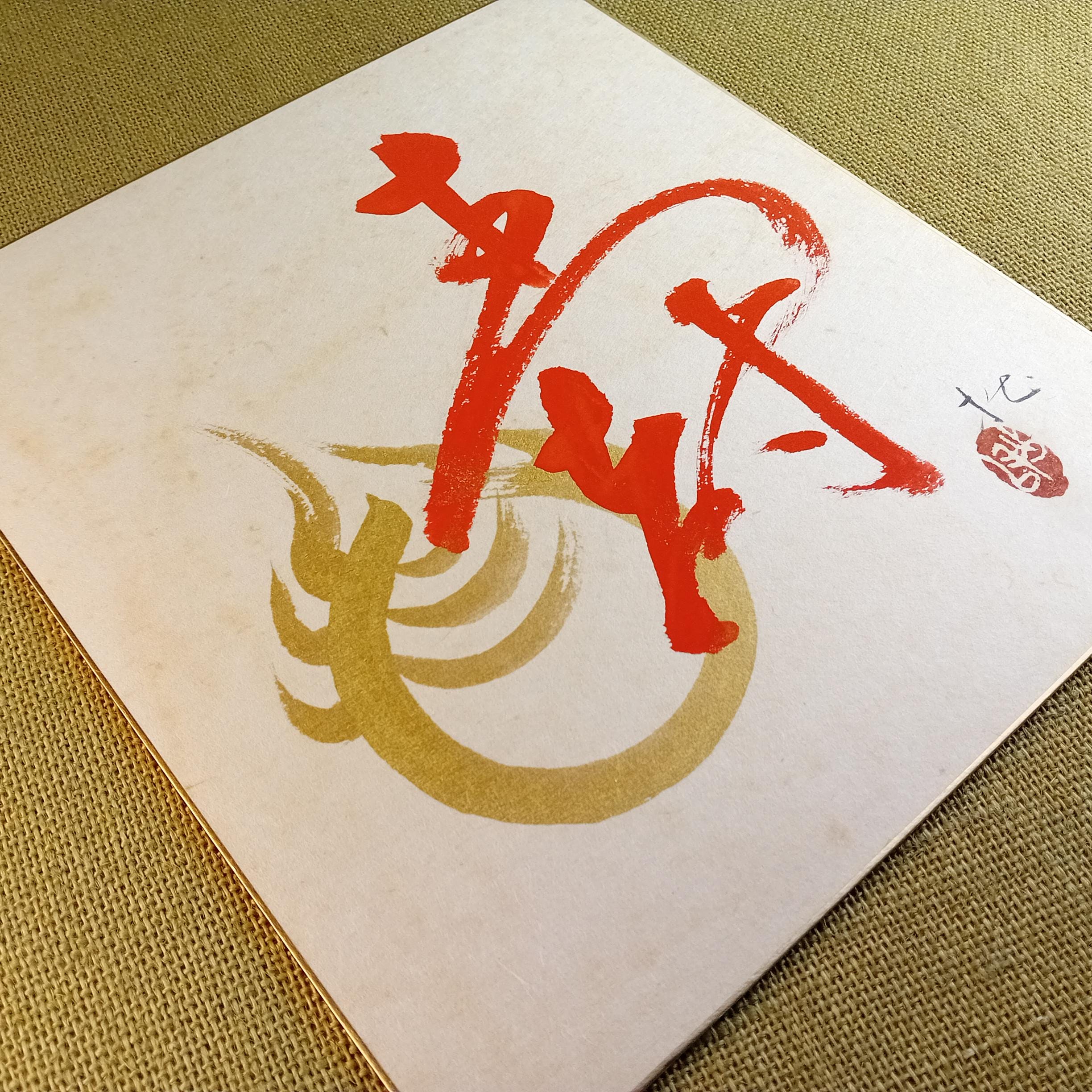
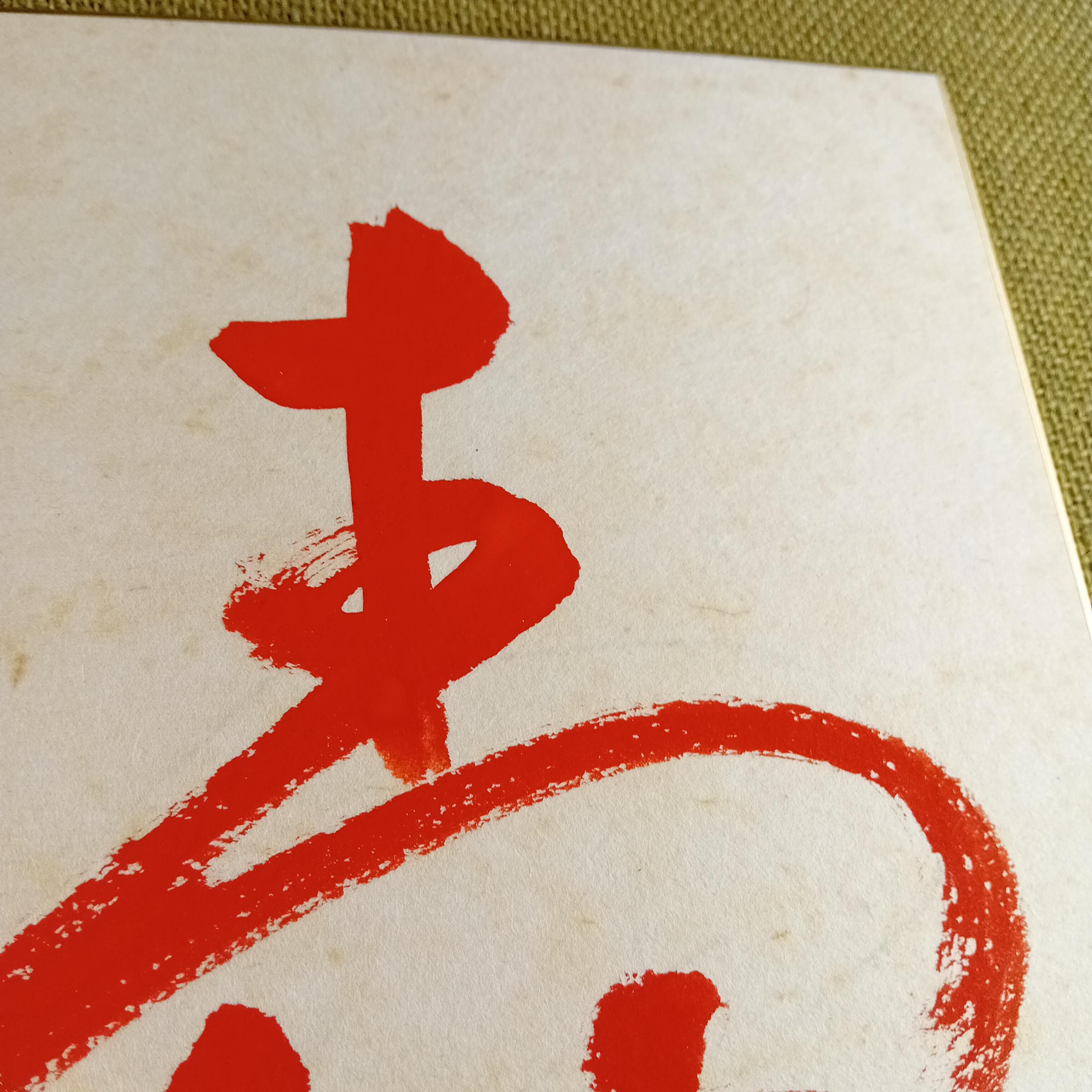
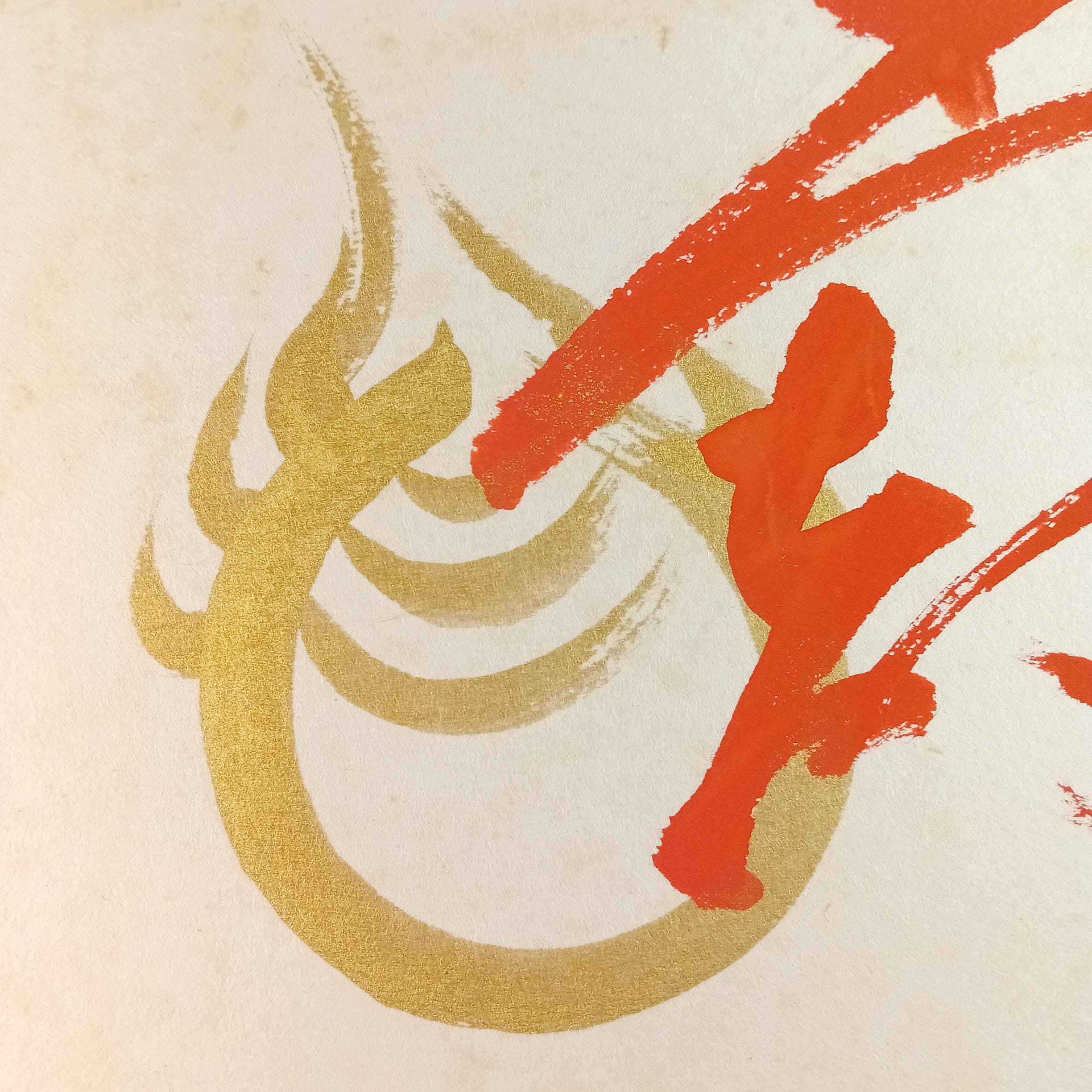
Kawakami Setsui - vintage Showa Japanese painting and calligraphy on shikishi - happiness and longevity
$434.76
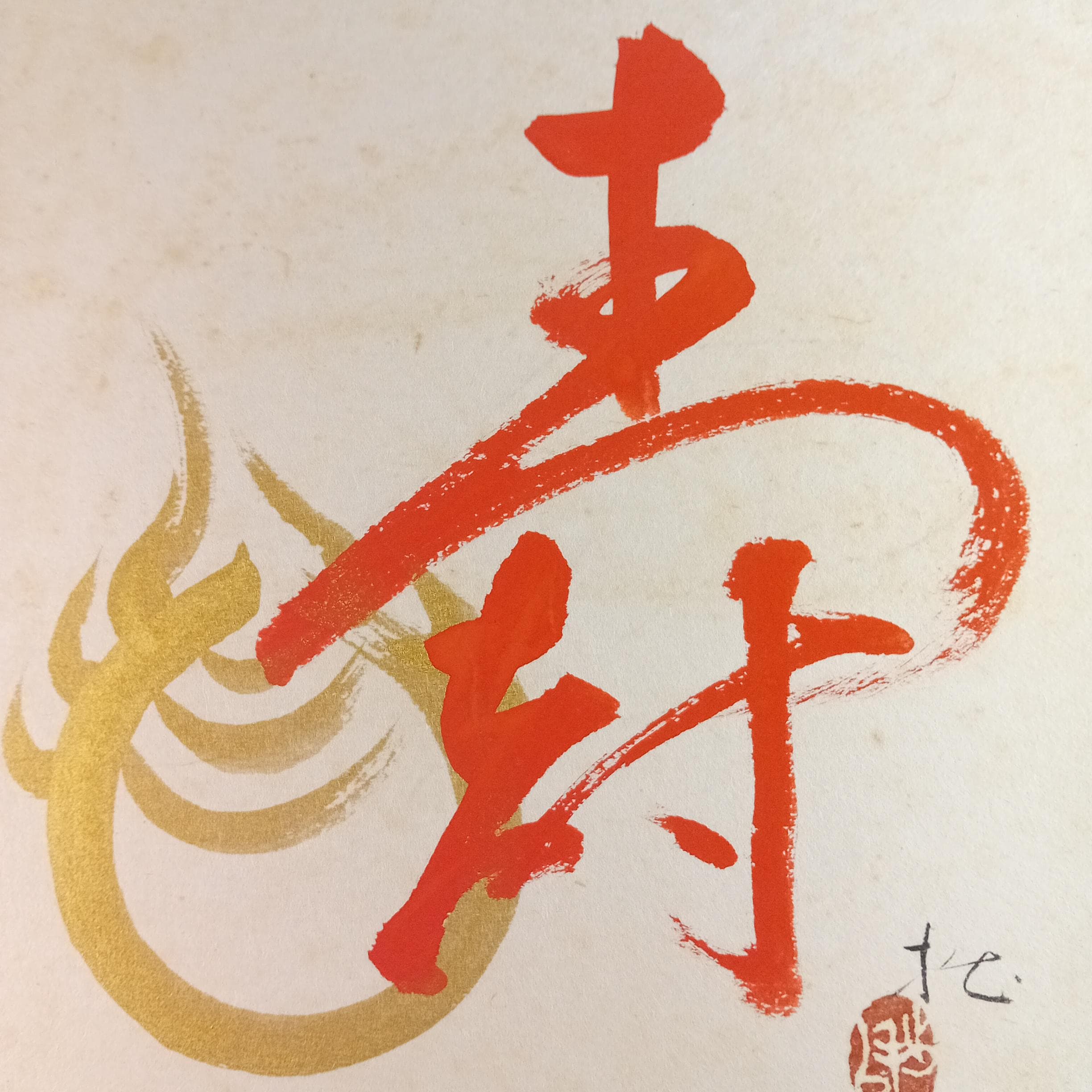
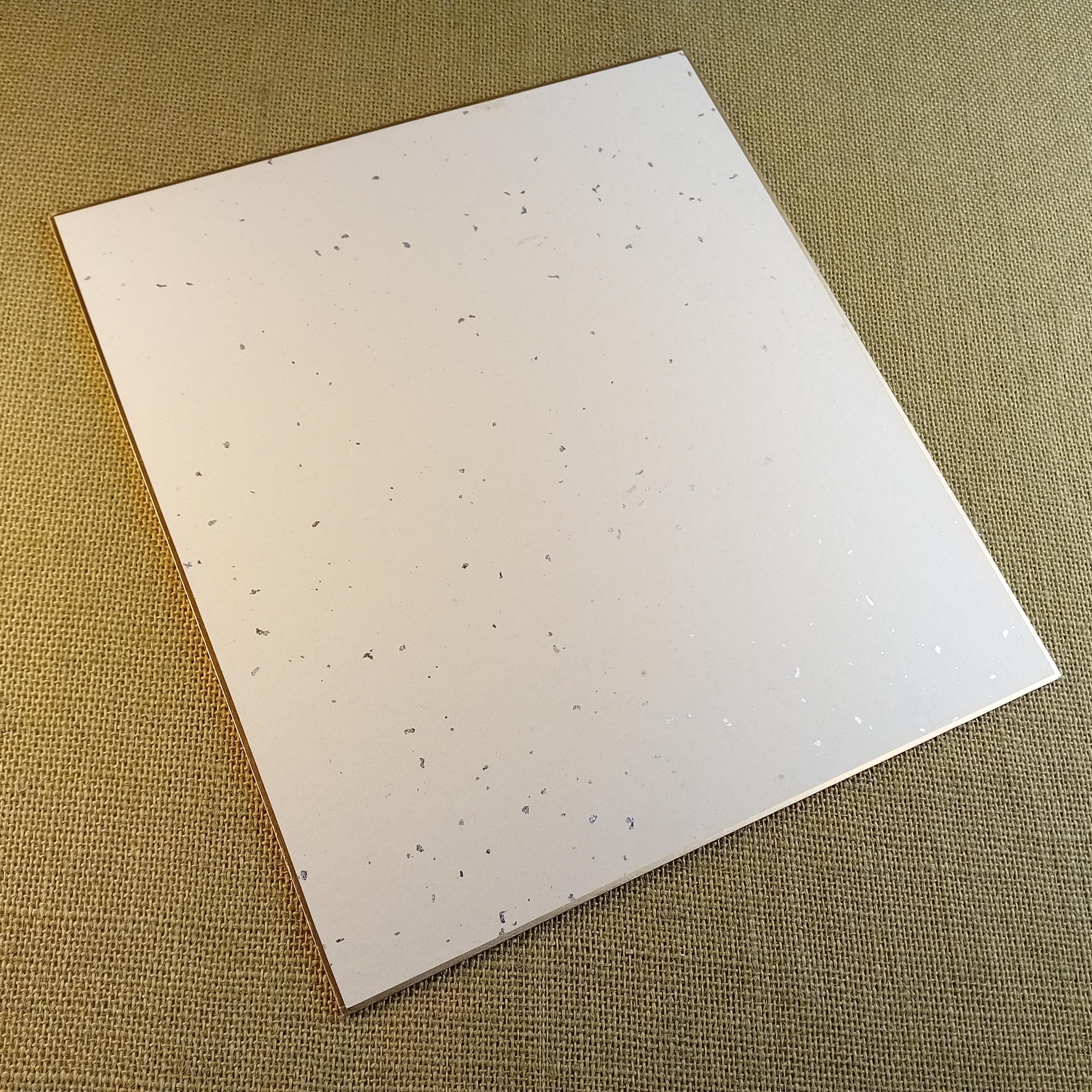
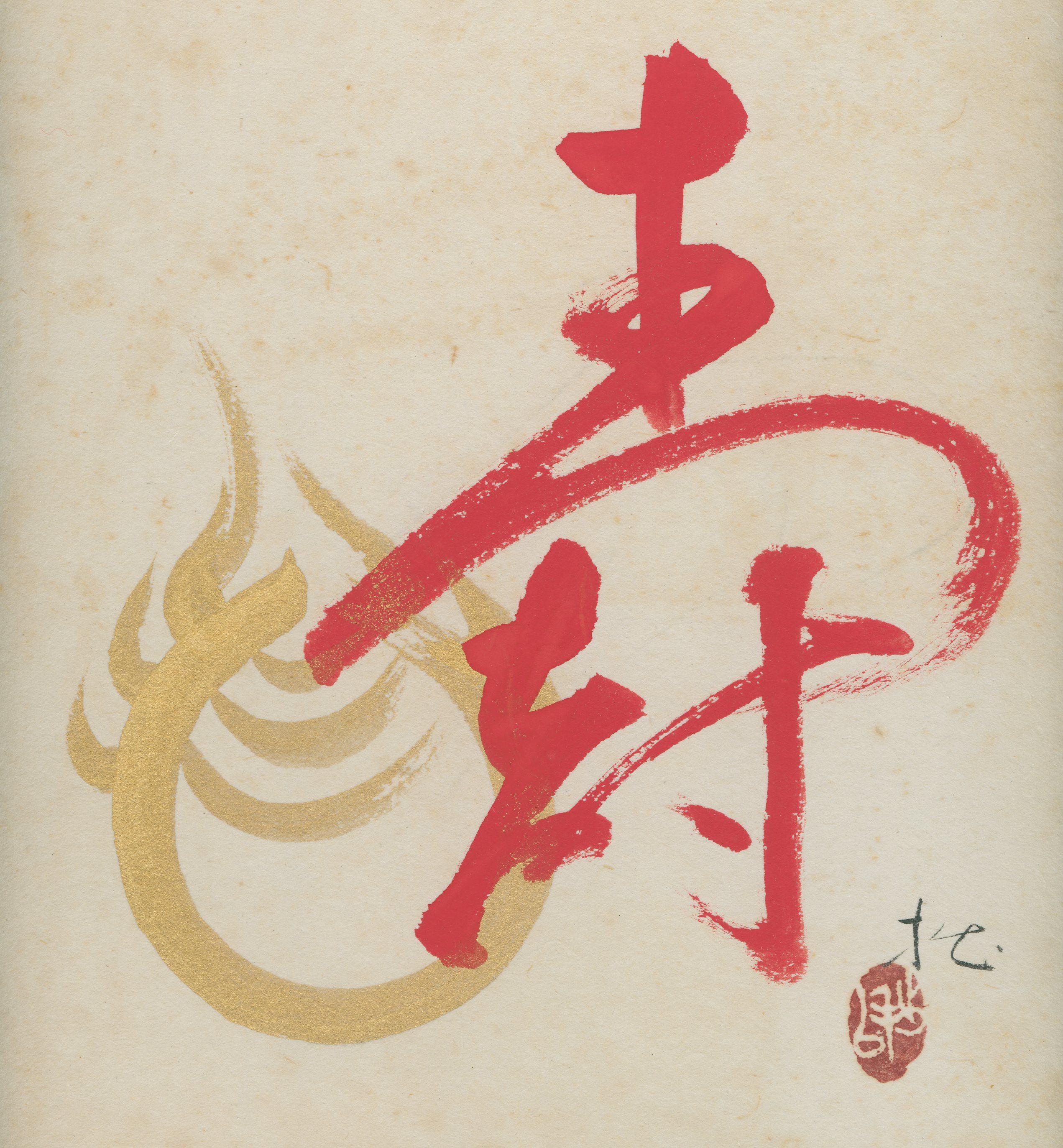
Original Japanese calligraphic painting by Kawakami Setsui on a traditional shikishi board.
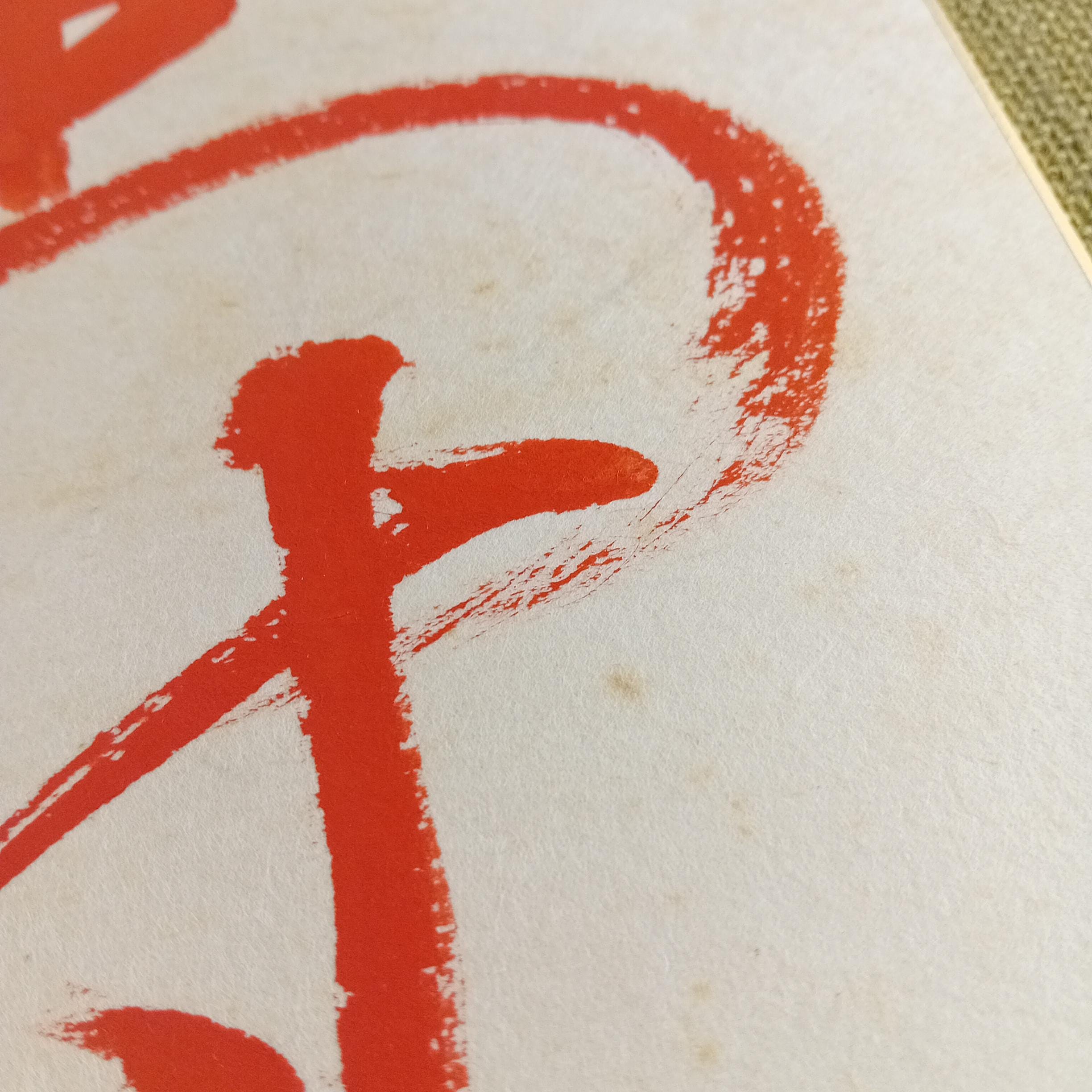
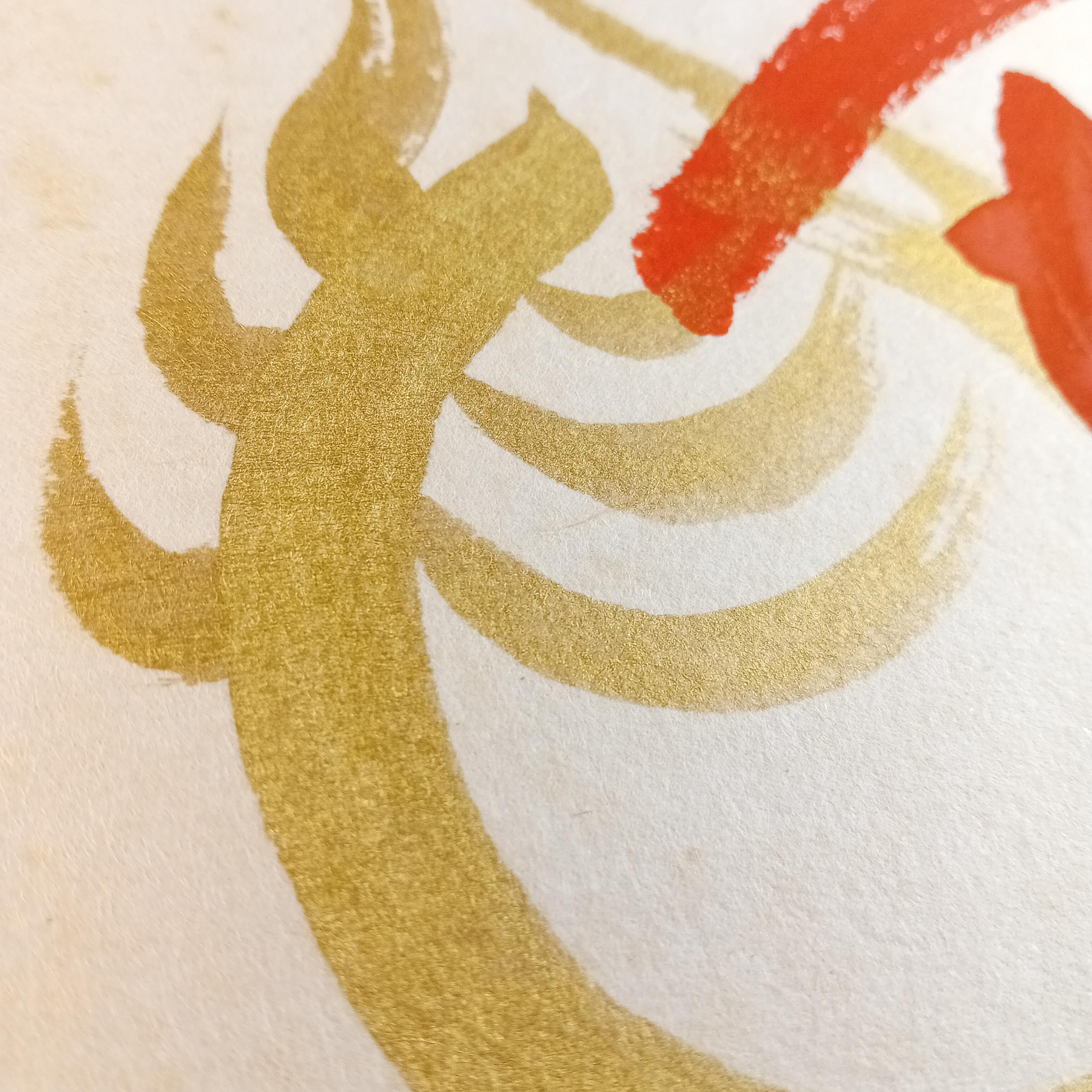
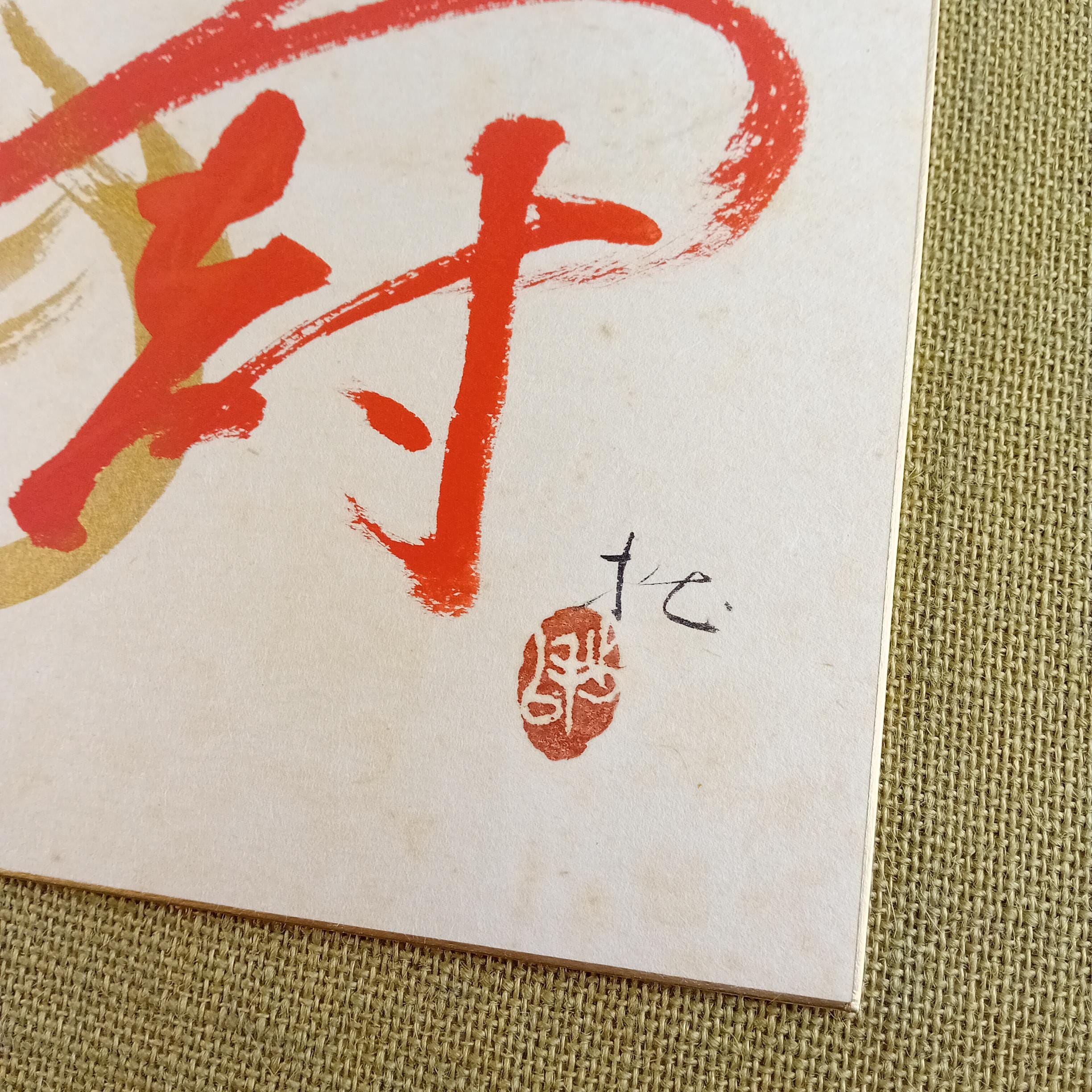
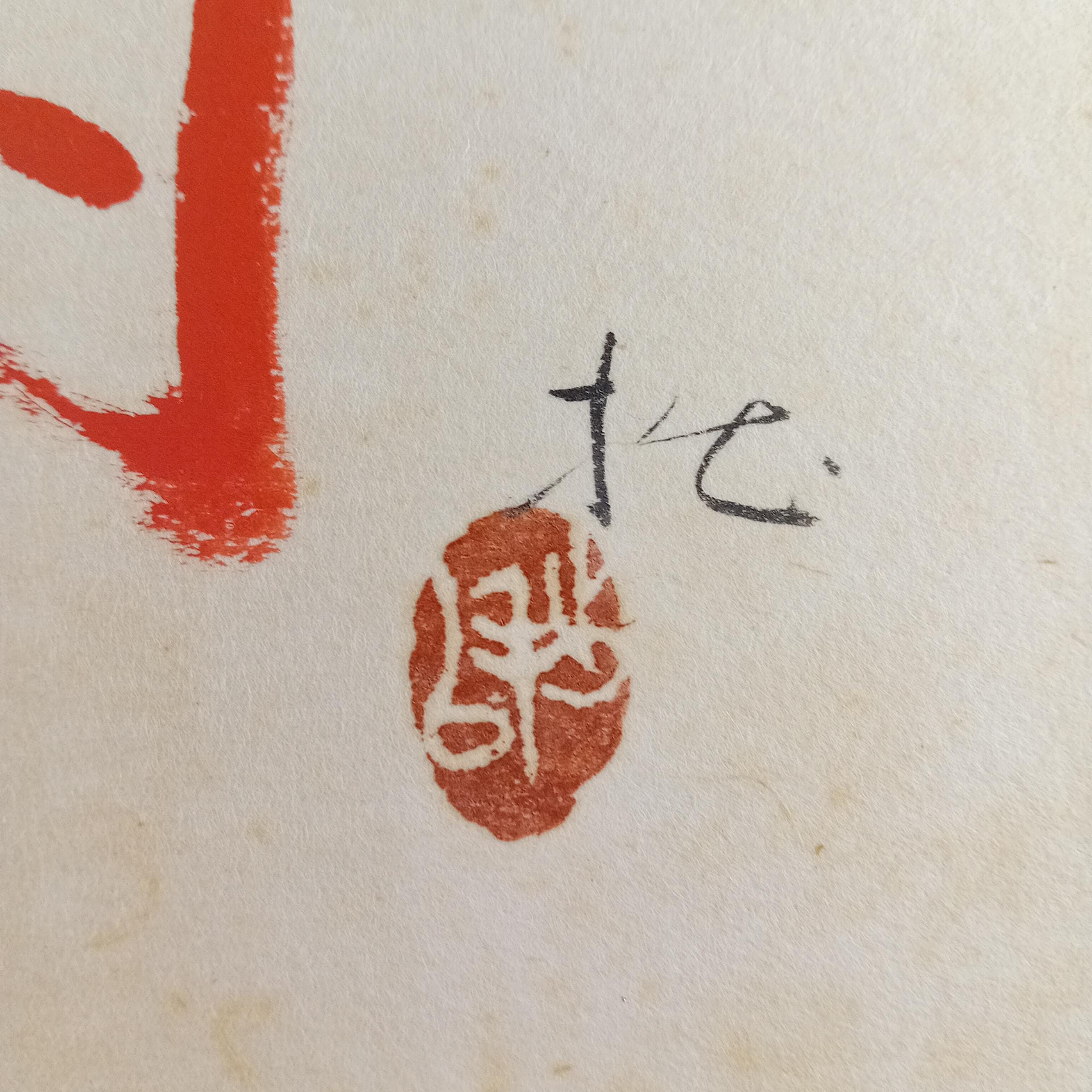
The composition is executed in red and gold coloured metallic pigment. Broad, freely controlled brush movements combine traditional auspicious themes of happiness, prosperity, and longevity. The red calligraphic form dominates the composition, while the gold element creates a second visual layer. The work is signed and bears the artist’s red seal.
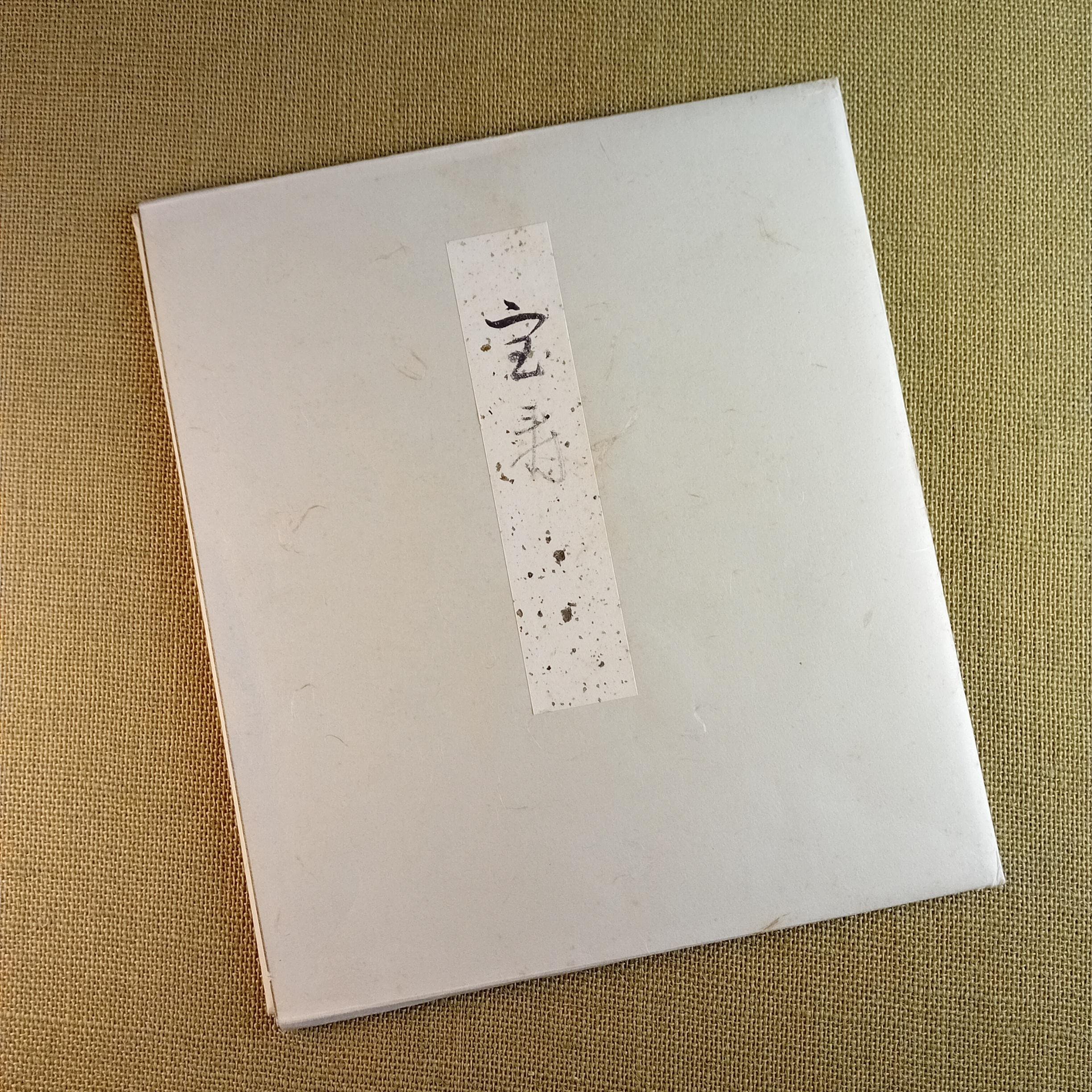
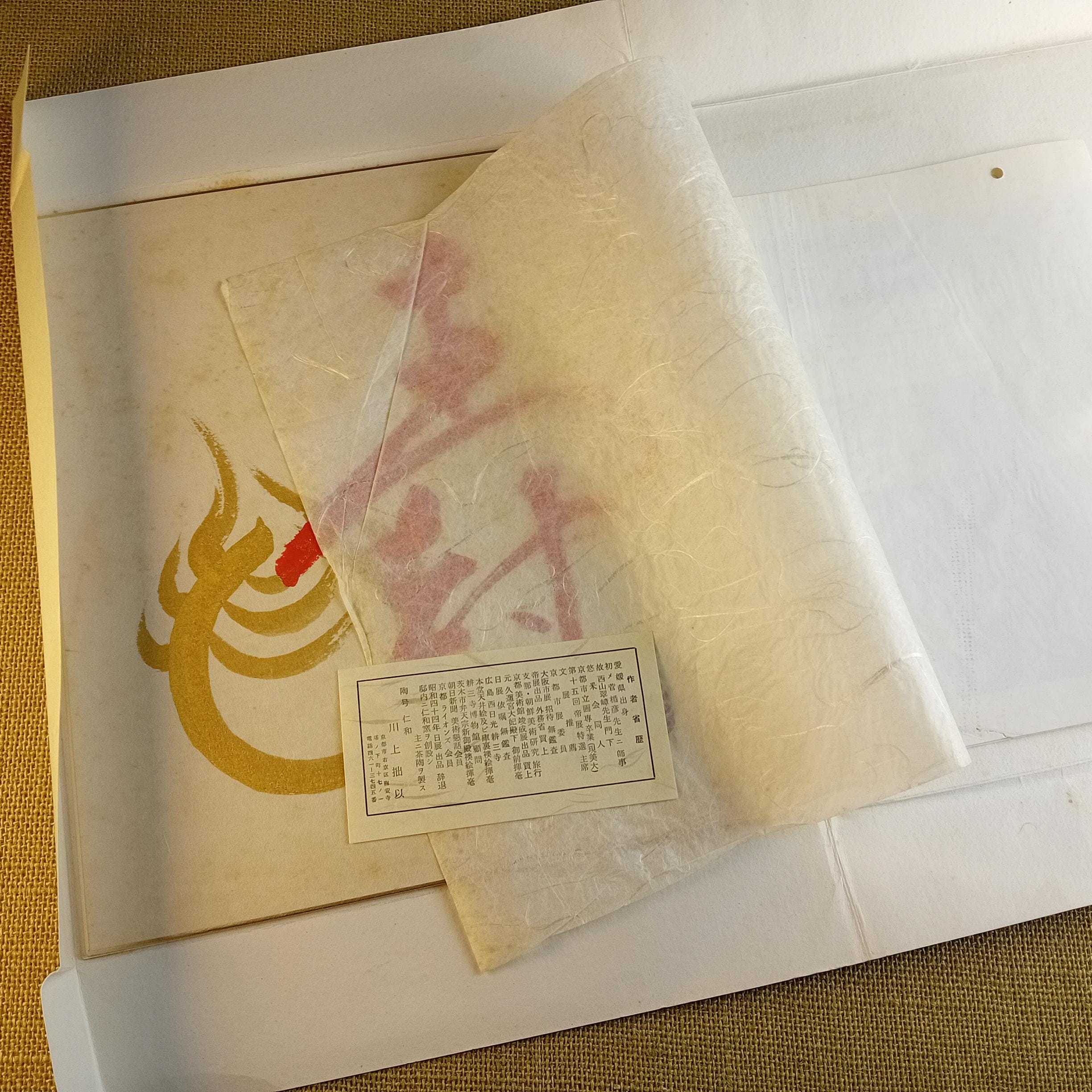
The shikishi is preserved in its original paper wrapper with a handwritten identification of the work and the artist. Two period documents were kept inside.
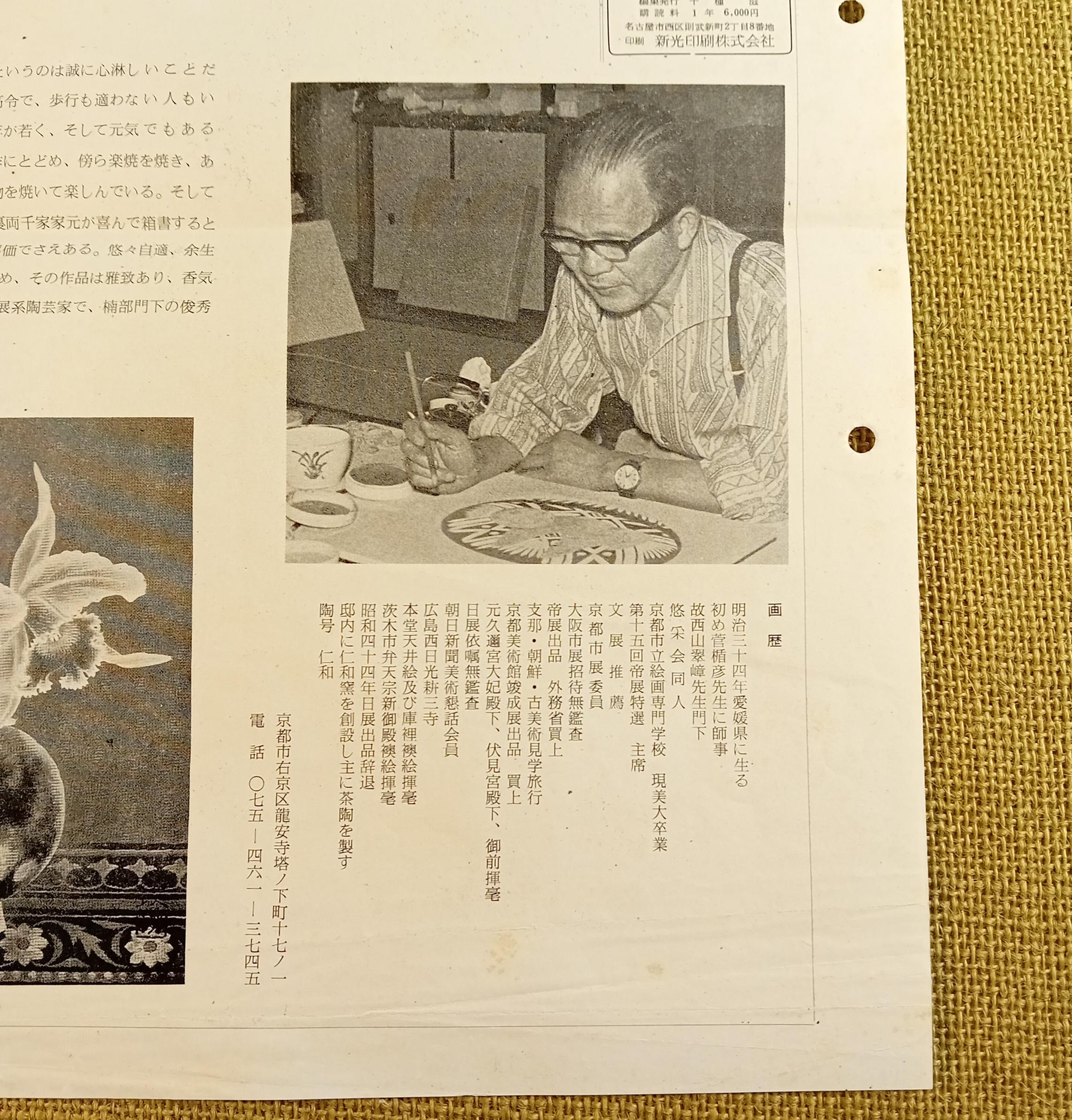
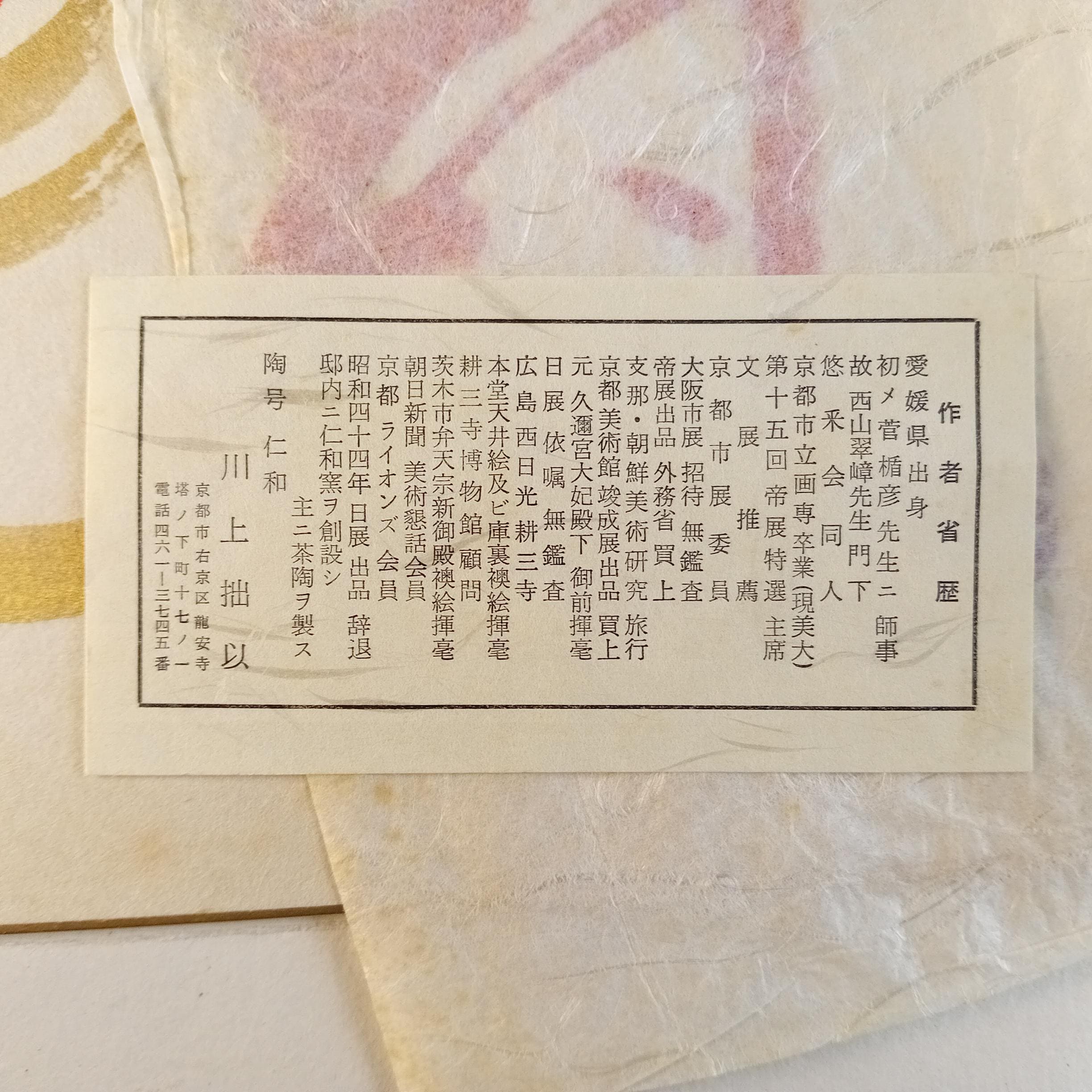
A biographical card listing the artist’s education, awards, exhibitions, and monumental commissions.
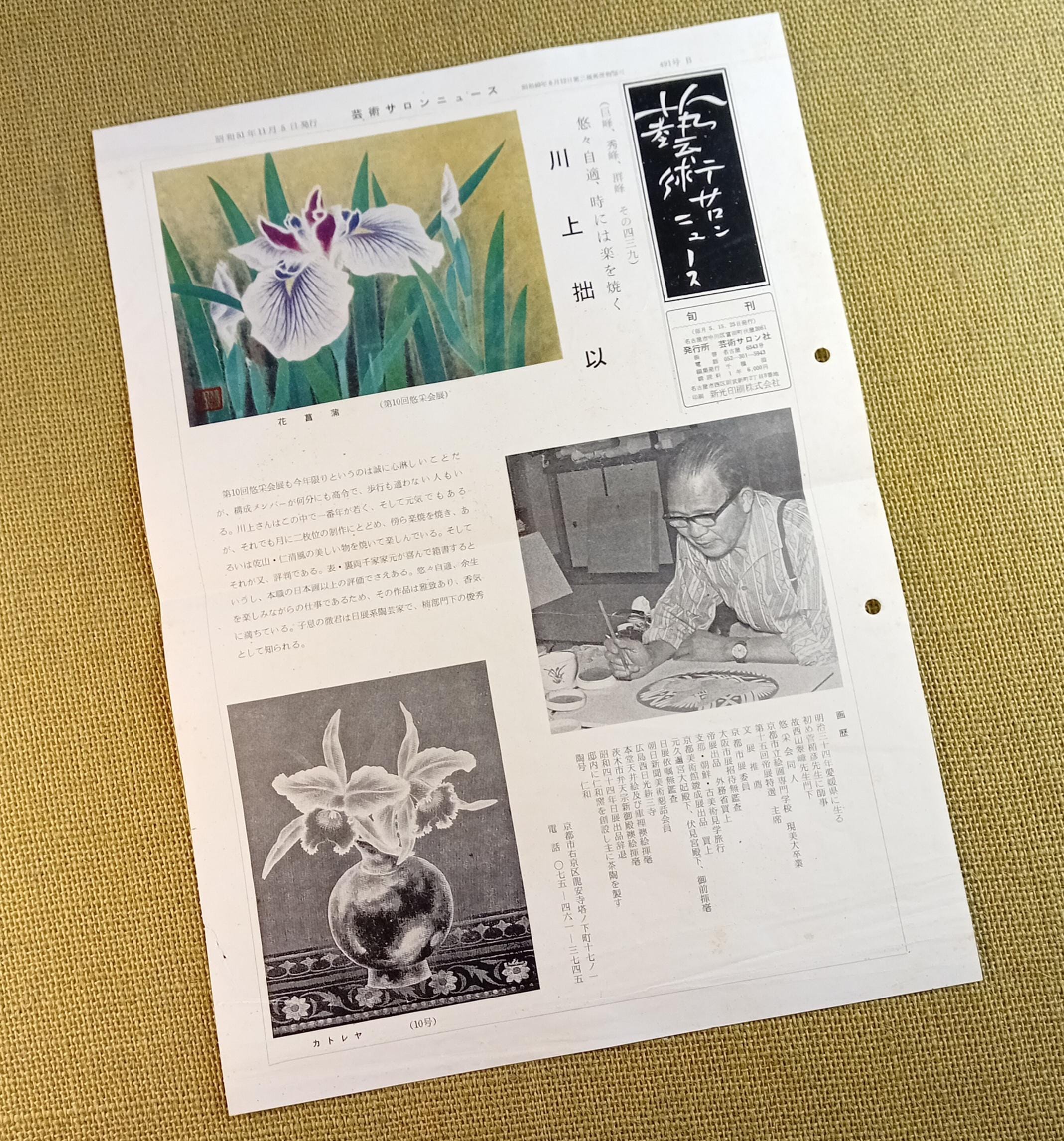
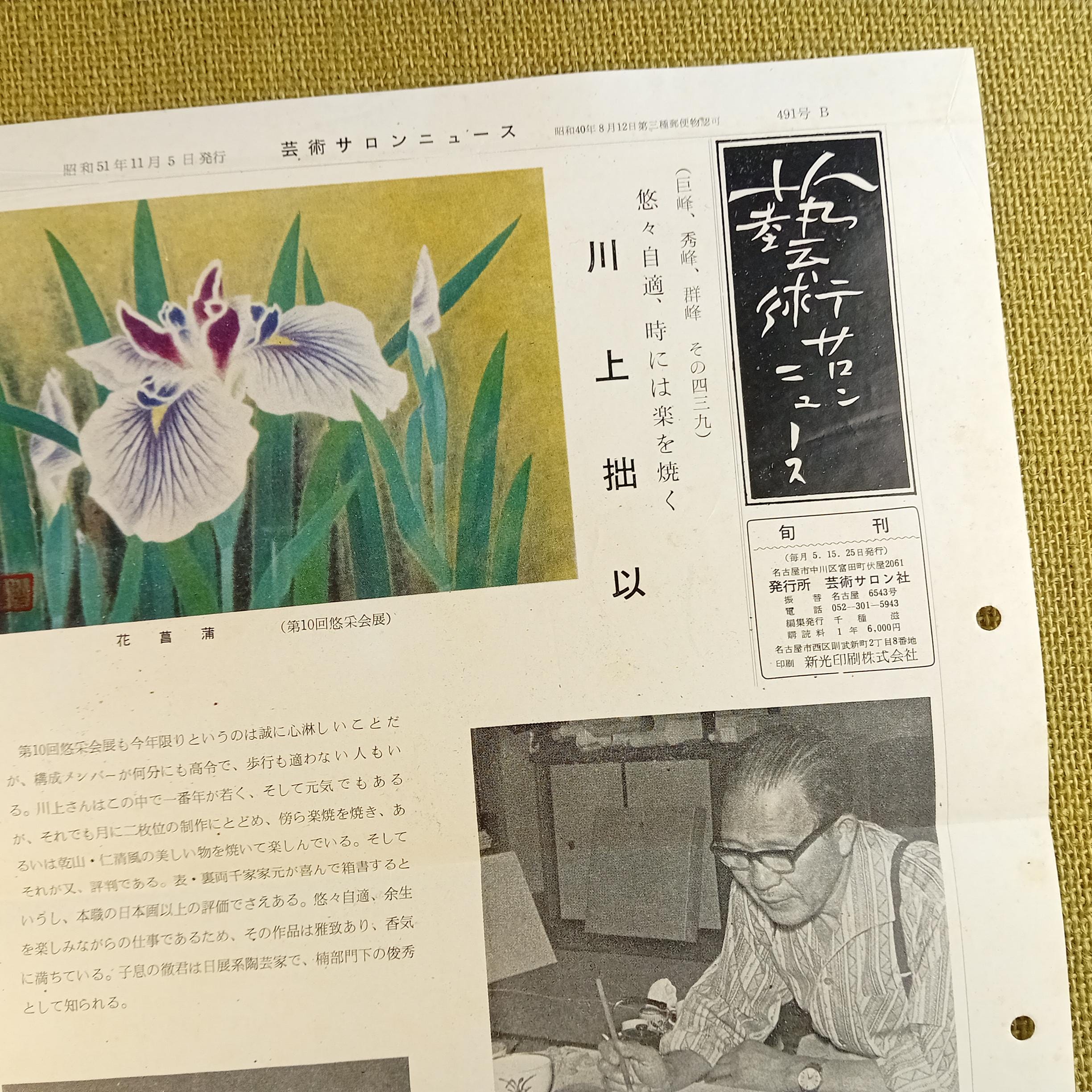
A page from Art Salon News, issue 491 B, published on 5 November 1976.
The publication includes a photograph of Kawakami Setsui at work, reproductions of his late paintings, a biographical record, and an article discussing both his painting and ceramic practice. It also documents his participation in the tenth and final exhibition of the Yusai kai artists’ group.
Kawakami Setsui died on 3 December 1976, only 28 days after the publication of this issue. The enclosed page is therefore one of the last publications about the artist issued during his lifetime. It does not establish the exact date of the shikishi, but securely connects the work, wrapper, and accompanying documents with the final period of his career.
About the artist
Kawakami Setsui, 1901-1976, was a professional Kyoto based nihonga painter.
Born in Ehime Prefecture, he first studied under Suga Tatehiko and later under Nishiyama Suisho. He graduated from the Kyoto Municipal Special School of Painting, later incorporated into Kyoto City University of Arts.
Setsui participated in the official Teiten, Bunten, and Nitten exhibition systems. At the fifteenth Teiten exhibition, he received a special award and first place. He was also associated with the early Seikosha painting group and later exhibited with Yusai kai.
Works by Kawakami Setsui are held in Japanese museum collections, including the National Museum of Modern Art, Tokyo, the Kyoto City Museum of Art, the Niihama City Museum of Art, and the Kosanji Museum.
For the Kosanji temple complex, Setsui executed ceiling paintings for the main hall and painted sliding panels for the interior buildings. His period biographical documents also record that he performed painting or calligraphy in the presence of the Dowager Princess of the Kuni imperial house and a member of the Fushimi imperial house.
In his later years, Setsui established the Ninna kiln at his home and produced ceramics for the tea ceremony, including raku ware and works influenced by the traditions of Kenzan and Ninsei. The 1976 publication states that his ceramics achieved considerable recognition and that the heads of both Omotesenke and Urasenke provided inscriptions for the storage boxes of his works.
Documentary contents
Original signed and sealed shikishi
Original paper wrapper
Period biographical card
Art Salon News, issue 491 B, dated 5 November 1976
The documents were preserved together with the artwork and form a coherent archival group.
Condition
Vintage condition. Vintage works may show natural signs of age (light toning, small fiber creases, gentle edge wear), so please review the photos carefully.
The wrapper, biographical card, and publication page show folds, edge wear, and other natural signs of storage.
Size
Size of the shikishi (approx.): 24 x 27 cm.
Shipping
Safe and tracked shipping from Latvia (Riga Gallery of Japanese Art CloudyYokomido).
For US buyers
US customs processing is prepaid through the shipping service, so no additional customs processing payment is required upon delivery.
Shipping from Latvia
Processing time
1-3 business days
Customs and import taxes
Buyers are responsible for any customs and import taxes that may apply. I'm not responsible for delays due to customs.
Payment Options
Returns & Exchanges
Returns accepted within 14 days
Buyers are responsible for return shipping costs. If the item is not returned in its original condition, the buyer is responsible for any loss in value.
I gladly accept cancellations
Request a cancellation within: 1 hours of purchase